


Key findings
Most AI initiatives never scale beyond pilots, not because of weak technology, but because organizations aren’t aligned or ready. The Typeface Signal Report (2025) shows 82% of marketers use AI, yet few move past experimentation. Key blockers include compliance uncertainty, poor data quality, lack of integration support, and limited executive backing.
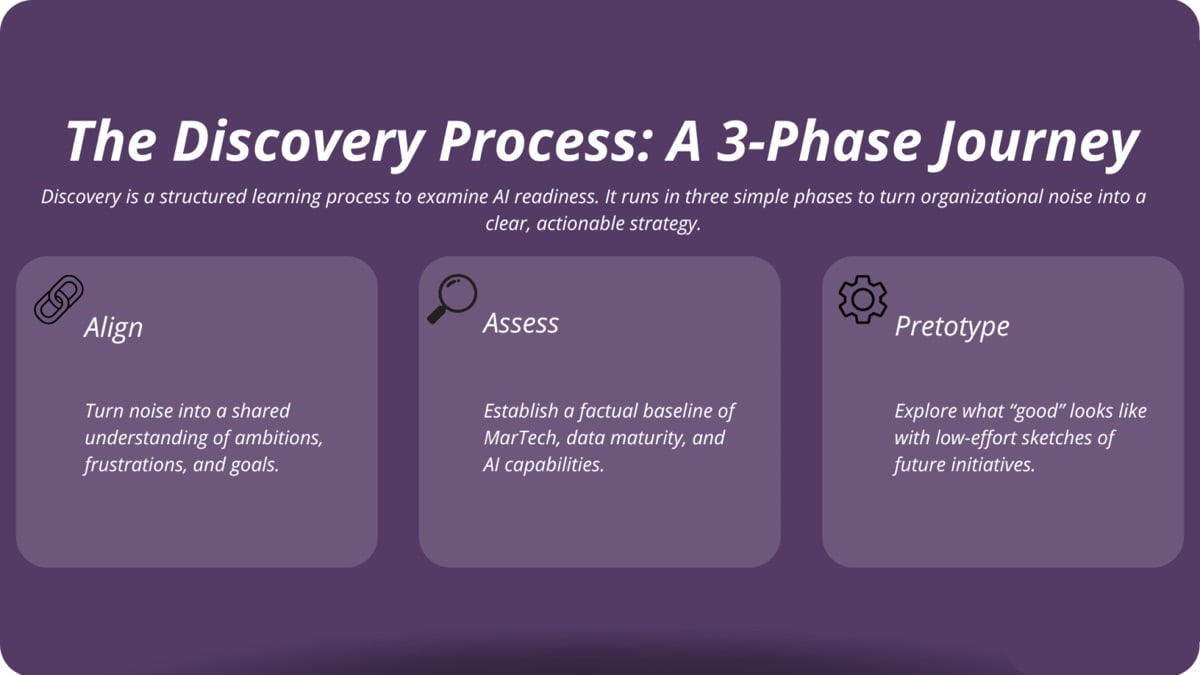
Marchitechs’ Discovery is a process that helps leadership teams test readiness before scaling. It’s a three-step approach:
- Align – Create shared understanding across functions.
- Assess – Establish a factual baseline of data, tech, and governance maturity.
- Pretotype – Sketch practical next steps before major investment.
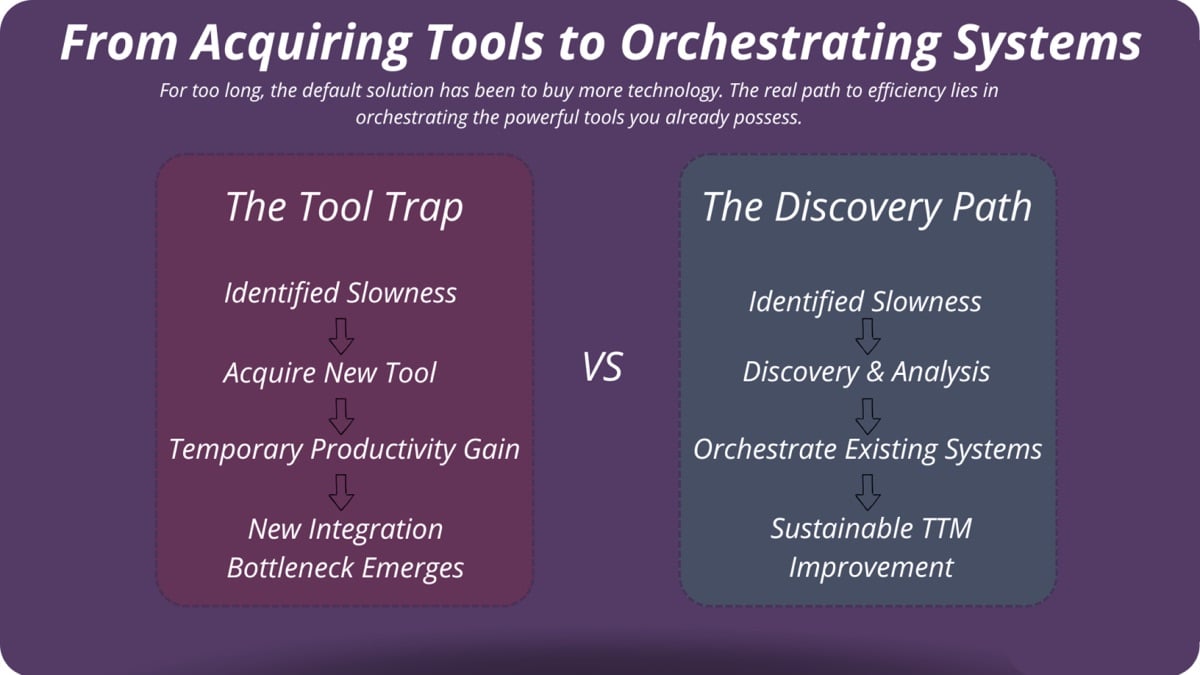
Discovery is less about buying tools and more about orchestrating the ones you already have, turning readiness into real execution.
AI Readiness Checklist & Barrier Identification
AI has moved from curiosity to boardroom agenda. Most organizations have started experimenting, often enthusiastically, but progress slows once the pilots end. Teams see promise, but scaling feels just out of reach.
Before investing in new tools or talent, it’s worth pausing to ask: Are we truly ready for AI, or are we still testing the water without a plan to swim?
Insights from Typeface (2025)
According to The Typeface Signal Report (2025), the marketing function is at a breaking point.
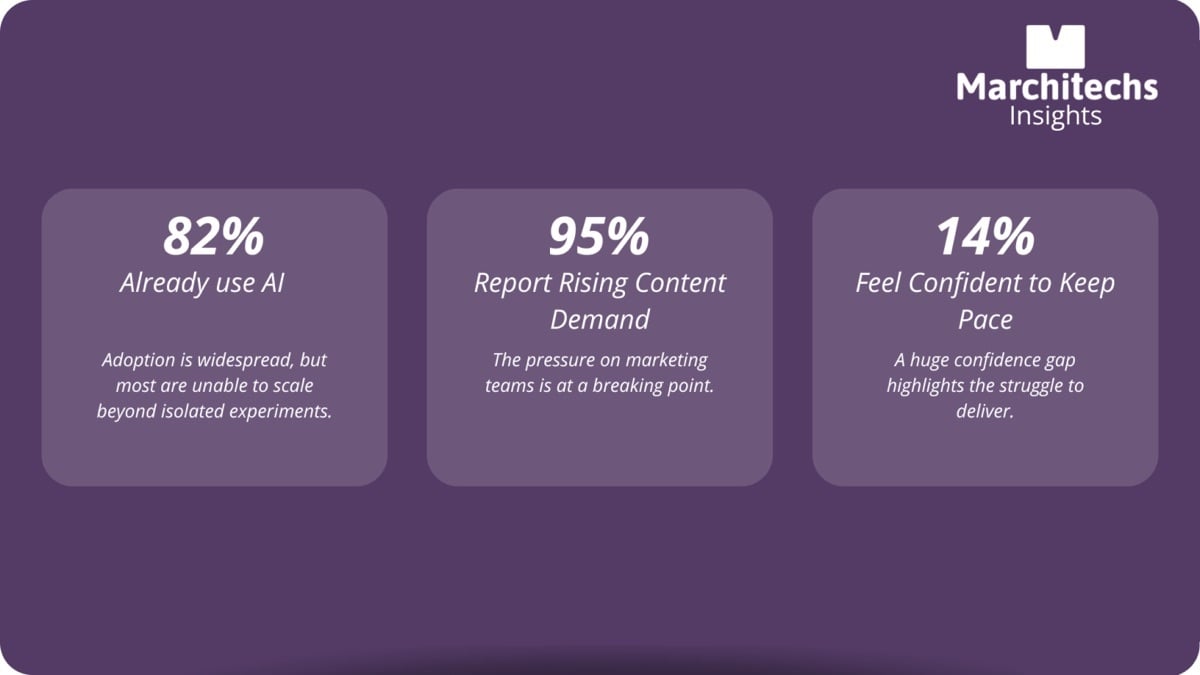
Even though 82% already use AI in some form, most remain stuck in pilot mode, unable to scale beyond isolated experiments(Typeface, 2025, The Typeface Signal Report).
The research highlights key barriers that prevent AI from delivering enterprise value:
- Compliance and legal uncertainty 56% cite privacy and governance issues as blockers.
- Poor data quality 48% report unreliable inputs undermining AI outputs.
- Limited technical resources 53% lack integration support from IT.
- Cultural resistance teams hesitate to trust or adapt to new workflows.
- Weak executive sponsorship only 22% of failed pilots had clear leadership backing (Typeface, 2025).
The numbers paint a consistent story: technology adoption isn’t the issue, orchestration is. Typeface (2025) concludes that success depends on three imperatives:
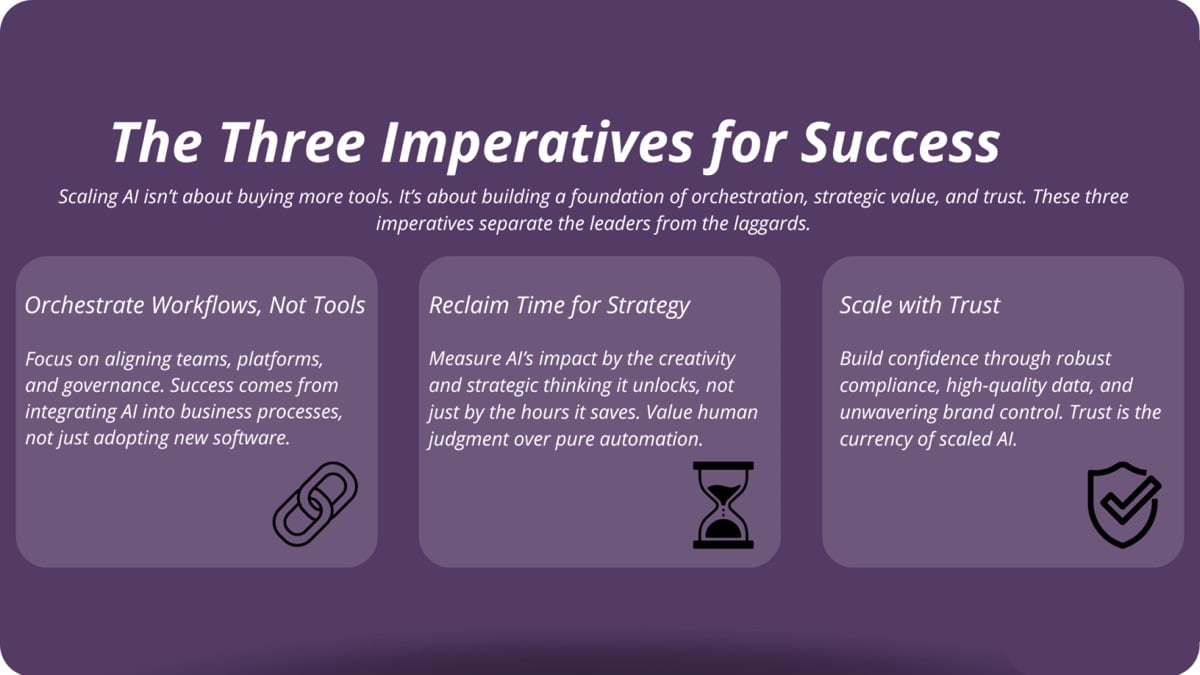
In short: AI can accelerate marketing, but only if the organization itself is ready to keep up.
Where Readiness Breaks Down
At Marchitechs, we often see the same patterns play out. A company invests heavily in a new AI capability, maybe an automated content system or predictive model, but adoption stalls. Marketing teams don’t trust the data, IT doesn’t prioritize integration, and compliance wants to review every prompt.
This is not a technology failure. It’s an alignment failure. AI programs succeed when leadership sets a clear direction, defines governance early, and ensures teams have a shared understanding of “why” and “how.” Without that foundation, even the best tools become isolated experiments.
Marchitechs Discovery: A Structured tool you should know before you scale
Think of Discovery not as a product but as a structured learning process. It’s how leadership teams can step back and examine whether their organization is ready, and where they need to adjust before scaling.
The Discovery approach runs in three simple movements: Align, Assess, Pretotype.
1. Align – Turning noise into shared understanding
Alignment isn’t about everyone agreeing; it’s about everyone seeing the same landscape. Discovery starts by bringing the CMO, CIO, and heads of data, compliance, and marketing together for a candid discussion.
The goal is to map out the current situation, ambitions, frustrations, and blind spots. Where is AI expected to create value? What’s working today? What’s blocking progress?
Many teams find that this single step surfaces hidden misalignments: IT teams might prioritize stability, while marketing pushes for experimentation. The Discovery process forces those differences into the open so strategy can account for them, rather than be derailed by them later.
2. Assess – Establishing a factual baseline
Next comes an evidence-based look at your MarTech and AI capabilities. Here you should use data collected through structured surveys and internal input sessions, mapping your stack, processes, data maturity, and governance readiness.
This phase isn’t about judgment; it’s about clarity. Leaders gain a grounded picture of where the organization actually stands versus where it wants to be.
This exercise turns opinions into observable facts. Typeface (2025) notes that 72% of successful AI deployments rely on high-quality data, and over half require seamless system integration and strong governance controls, all of which the Discovery process helps you evaluate.
The result is a shared, data-backed baseline for decision-making, the first step to moving AI from promise to production.
3. Pretotype – Exploring what “good” looks like
Finally, move from assessment to action by developing “roadmap pretotypes.” These are low-effort, high-value sketches of what future initiatives might look like, before you invest in them.
Each pretotype estimates effort, dependencies, and potential business outcomes, turning abstract ambition into visible, testable direction. Leaders can then choose where to invest, confident they understand the scale of change required.
Why Discovery Matters Now
When Typeface (2025) found that 69% of marketing campaigns still take 3–4 weeks to launch while most leaders expect 1–2 weeks, it underlined a deeper truth: time-to-market is now a governance issue, not just a productivity one.
Discovery helps leaders connect that operational lag to the underlying structures, whether it’s workflow fragmentation, unclear accountability, or low data readiness. It’s not a workshop to buy technology; it’s a mirror held up to how your organization manages it.
For many executives, the insight isn’t “we need new tools” but rather “we need to rethink how we orchestrate the ones we have.”
From Readiness to Realization
AI at scale won’t replace people, but it will reward those who know how to align them. The organizations that succeed will be the ones that use structured learning to bridge strategy and execution.
Marchitechs’ Discovery approach is one way to make that learning tangible. It helps leadership teams test readiness, surface hidden barriers, and move forward with clarity.
And that’s where real transformation begins: not in another pilot, but in the discipline of understanding what your organization is truly ready to handle.
If your pilots keep stalling, it’s worth asking, is it a tech problem, or a readiness one?
Want to get in touch?
Reach out to the Marchitechs team or connect directly with one of the authors here on LinkedIn.
Written by Martin Schierning Wammen, Jens Borgkvist, Troels Rem and Anders Bjørn-Strunge
The content and perspectives are based on experiences managing, implementation of CDPs, Marketing Suites, and customer data infrastructure projects across multiple industries in Nordic and global enterprises. The point-of-view is European-centric in terms of business,technology, and data privacy context
References; Typeface (2025) The Typeface Signal Report: Insights from marketing leaders – where AI pilots stall and how to scale successfully. San Francisco: Typeface.
https://www.typeface.ai/resources/u/9ddb9dd5d8aee9a76bf217a2a3c54833/typeface-signal-report-25.pdf