
Most MarTech strategies do not begin because an organisation suddenly decides it needs a strategy.
They begin because something changes.
A new CMO or CIO joins and asks a practical question: what do we have, what is it doing for us, and what should change? A privacy or consent change disrupts journeys, tracking, or attribution. A core platform approaches end-of-life, and suddenly every vendor has a different view of the future. Or the board asks for proof that MarTech spend is creating value, and the answer is harder to defend than expected.
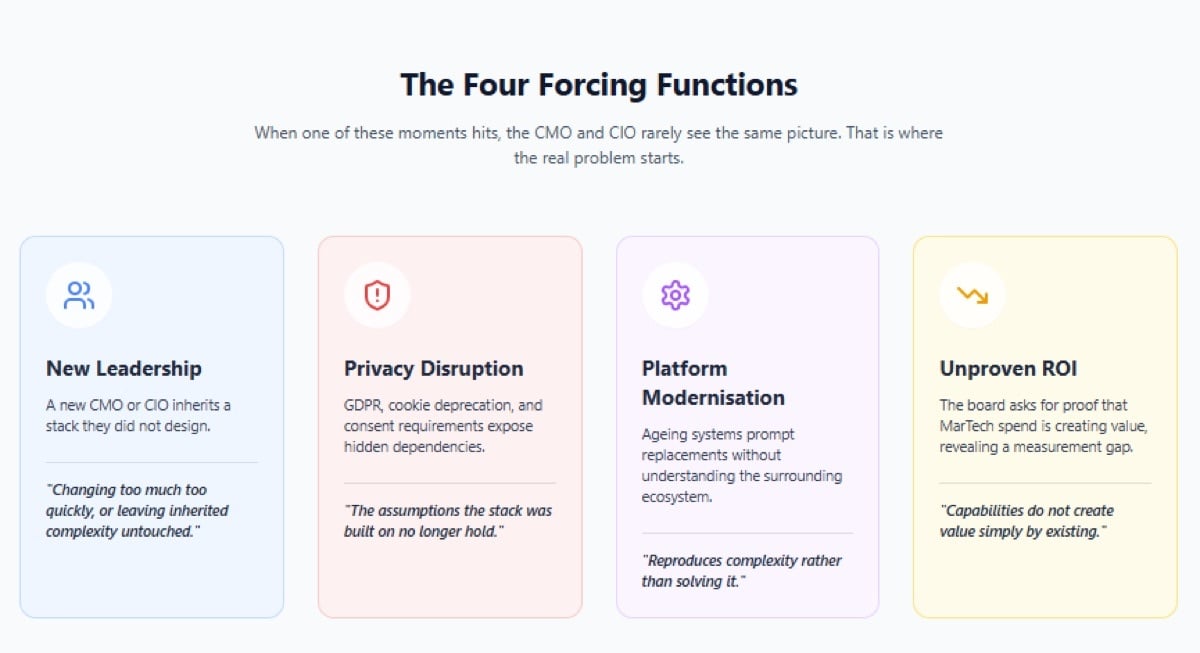
These are the four moments described in What sparks a MarTech strategy? Four moments that force the conversation: new leadership, privacy disruption, platform modernisation, and unproven ROI. The central point is simple but important: when one of these moments hits, the CMO and CIO rarely see the same picture (Wammen and Marchitechs Discovery, 2026).
That is often where the real problem starts.
Not in the tools themselves, but in the lack of a shared baseline.
MarTech is no longer just a marketing question
For years, MarTech could be treated as a collection of marketing tools: campaign platforms, CMS systems, analytics, CRM extensions, personalisation engines, CDPs, consent tools, and reporting layers.
That view is now too narrow.
Modern MarTech sits across marketing, IT, data, legal, sales, service, and finance. It shapes how customer journeys are executed, how data is collected, how consent is managed, how performance is measured, and how leadership evaluates commercial impact.
Research on business and IT alignment supports this point. Chau et al. (2020) show that alignment between business strategy, IT strategy, and IT governance is associated with firm performance, especially when organisations also have effective governance mechanisms in place. In other words, value does not come from technology alone. It comes from the fit between strategy, systems, governance, and execution.
That is highly relevant to MarTech.
A marketing automation platform, CMS, CDP, or analytics setup may be technically functional and still fail strategically if it is not connected to the organisation’s priorities, operating model, data architecture, and decision-making routines.
The first trigger: new leadership
A new CMO or CIO often inherits a stack they did not design.
There may be years of accumulated decisions: platforms bought for specific campaigns, regional workarounds, overlapping vendor contracts, integrations that only a few people understand, and reporting logic that has become difficult to explain.
This creates an early leadership problem.
Before setting a vision, the new leader needs to understand the current state. What exists? What is used? What is duplicated? What is business-critical? What is underused? What is risky? What is creating value?
Wammen and Marchitechs Discovery (2026) frame this as the need for a shared baseline in the first 90 days. That baseline matters because it turns the stack from a list of tools into a decision-making object.
Without that shared baseline, new leadership can easily fall into one of two traps: either changing too much too quickly, or leaving inherited complexity untouched because no one can confidently explain it.
The second trigger: privacy disruption
Privacy change is one of the strongest forcing functions in MarTech.
GDPR enforcement, cookie deprecation, app tracking restrictions, consent requirements, and internal DPO findings can all expose hidden dependencies in the stack. A campaign that worked yesterday may stop firing correctly. Attribution may become less reliable. Personalisation may lose usable signals. Reporting may no longer support the same conclusions.
The issue is not only compliance. It is operational fragility.
Wammen and Marchitechs Discovery (2026) capture this well: when consent changes, “the assumptions the stack was built on no longer hold.”
Recent research on advertising measurement in a post-cookie environment points in the same direction. Hosahally et al. (2025) examine marketing mix modelling, multi-touch attribution, and incrementality in response to changes such as iOS updates and app tracking transparency. Their work highlights that marketers need more resilient measurement approaches as individual-level tracking becomes less dependable.
For MarTech strategy, this means privacy cannot be treated as a legal overlay. It affects architecture, data flows, campaign logic, measurement, and the credibility of performance reporting.
A privacy disruption should therefore trigger a deeper question: which parts of our stack depend on assumptions that may no longer be valid?
The third trigger: platform modernisation
Platform modernisation often starts with a practical problem.
The CMS is ageing. The marketing automation platform was bought years ago. The CRM architecture no longer reflects the business. A CDP discussion has started. Integration costs are increasing. Teams are spending more time maintaining workarounds than improving customer experience.
At this point, the organisation may assume it needs a replacement project.
But replacing one platform without understanding the surrounding stack can simply create a more expensive version of the same problem. Wammen and Marchitechs Discovery (2026) make this point directly: platform replacement without stack context tends to reproduce complexity rather than solve it.
Research on legacy systems and digital transformation supports this caution. Irani et al. (2023) find that legacy systems create significant challenges for transformation, especially when systems are interdependent, data is incompatible, or old architecture is embedded in wider operational processes.
That lesson applies strongly to MarTech.
A CMS decision is rarely just a CMS decision. It touches content operations, analytics, consent, personalisation, SEO, customer data, localisation, governance, and integrations with downstream systems.
Modernisation should therefore begin with the ecosystem, not the vendor shortlist.
The fourth trigger: unproven ROI
The most difficult MarTech question is often the simplest one:
What value are we getting from this?
Many organisations have made serious investments in platforms, data, integrations, agencies, internal teams, and operating models. But when leadership asks for proof, the answer can become fragmented.
Marketing may point to campaign performance. IT may point to stability and integration. Finance may look for cost discipline. Sales may ask whether leads are better. Customer teams may care about journey quality. The board may want a clearer link to growth, retention, or efficiency.
The result is often a measurement gap.
Research by Homburg and Wielgos (2022) shows that digital marketing capabilities can contribute to firm profitability, but their value depends on organisational and environmental conditions. The practical implication is important: capabilities do not create value simply by existing. They need to be activated, governed, measured, and connected to business outcomes.
That is why ROI discussions should not start with a narrow tool-by-tool audit.
They should start with a baseline across stack, use cases, operations, organisation, management, and objectives. These are the six lenses proposed by Wammen and Marchitechs Discovery (2026). Together, they create a more complete view of whether the MarTech environment is actually capable of producing measurable value.
The real purpose of a MarTech baseline
A baseline is not just documentation.
Done well, it gives leadership a common language for decisions.
It helps answer questions such as:
What platforms and vendors are currently in place? Which use cases are live, mature, or still aspirational? Where are workflows slow or dependent on manual effort? Do roles, responsibilities, and sourcing models match the ambition? Is governance strong enough to manage privacy, data, integrations, and performance? Are objectives clear enough to guide investment decisions?
This matters because MarTech problems are often misdiagnosed.
A team may think it has a platform problem when it actually has a governance problem. It may think it has a data problem when it actually has an operating model problem. It may think it needs more advanced technology when it has not fully activated the tools it already owns.
A shared baseline reduces that risk.
It gives the CMO, CIO, and wider leadership team a clearer starting point before decisions become expensive.
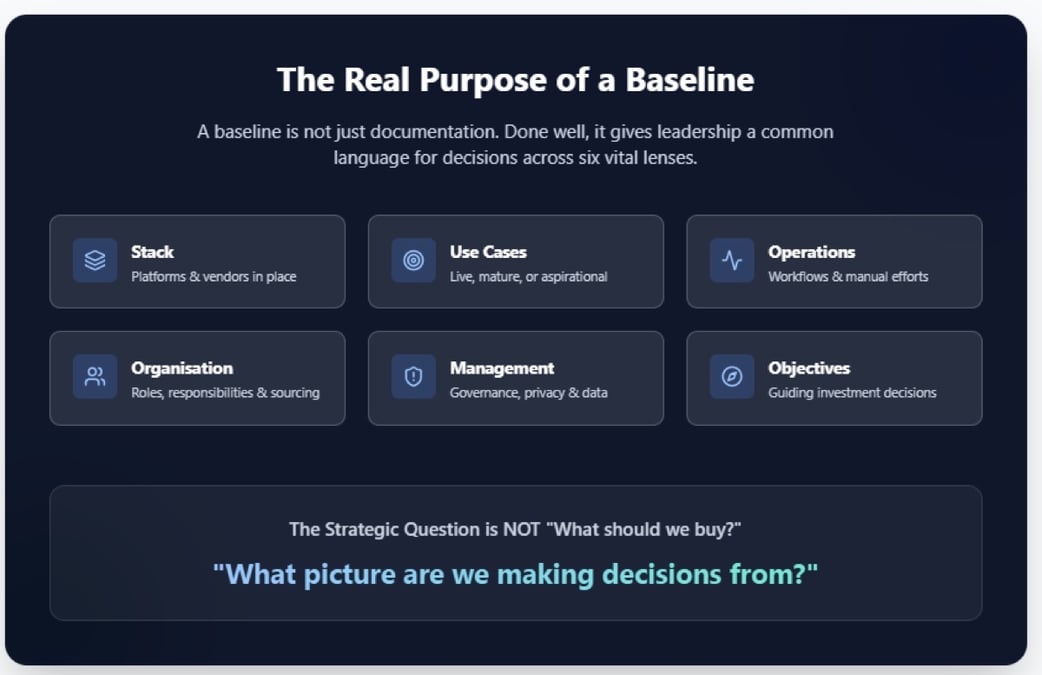
The strategic question is not “what should we buy?”
The more useful question is:
What picture are we making decisions from?
That question is especially important when the organisation is under pressure. New leadership, privacy disruption, platform modernisation, and ROI scrutiny all create urgency. But urgency without a shared baseline can lead to fragmented decisions.
Strong MarTech strategies are rarely built around technology alone.
They are built around alignment: between marketing and IT, between customer ambition and data reality, between governance and execution, and between investment and measurable business outcomes.
So when one of these trigger moments appears, it may be tempting to jump straight to action.
Replace the platform. Fix the tracking. Cut the spend. Buy the missing capability. Reorganise the team.
Sometimes those actions are necessary.
But the first move should often be more basic: establish the shared picture.
Because without that, every decision that follows is built on partial visibility.
And partial visibility is an expensive way to run MarTech.
References
Chau, D.C.K., Ngai, E.W.T., Gerow, J.E. and Thatcher, J.B. (2020) ‘The effects of business-IT strategic alignment and IT governance on firm performance: A moderated polynomial regression analysis’, MIS Quarterly, 44(4), pp. 1679-1703. doi:10.25300/MISQ/2020/12165.
Homburg, C. and Wielgos, D.M. (2022) ‘The value relevance of digital marketing capabilities to firm performance’, Journal of the Academy of Marketing Science, 50, pp. 666-688. doi:10.1007/s11747-022-00858-7.
Hosahally, S., Bharadwaj, M., Zaremba, A. and Volkova, O. (2025) ‘Measuring digital advertising in a post-cookie era: A study of marketing-mix models, attribution and incrementality’, Journal of Digital & Social Media Marketing, 12(4), pp. 348-373.
Irani, Z., Abril, R.M., Weerakkody, V., Omar, A. and Sivarajah, U. (2023) ‘The impact of legacy systems on digital transformation in European public administration: Lesson learned from a multi case analysis’, Government Information Quarterly, 40(1), article 101784. doi:10.1016/j.giq.2022.101784.
Wammen, M. and Marchitechs Discovery (2026) What sparks a MarTech strategy? Four moments that force the conversation. Marchitechs Discovery.