

Customer Data Platforms (CDPs) used to be evaluated on whether they could assemble a “360-degree view” of the customer. That is no longer enough. In an AI-driven, privacy-conscious environment, a modern CDP has to serve as a governed data foundation, support real-time decisioning, and fit the organisation’s actual maturity and stack.
Below is a view of what a modern CDP should be able to do, combining market research with Marchitechs’ own CDP landscape and architecture work.
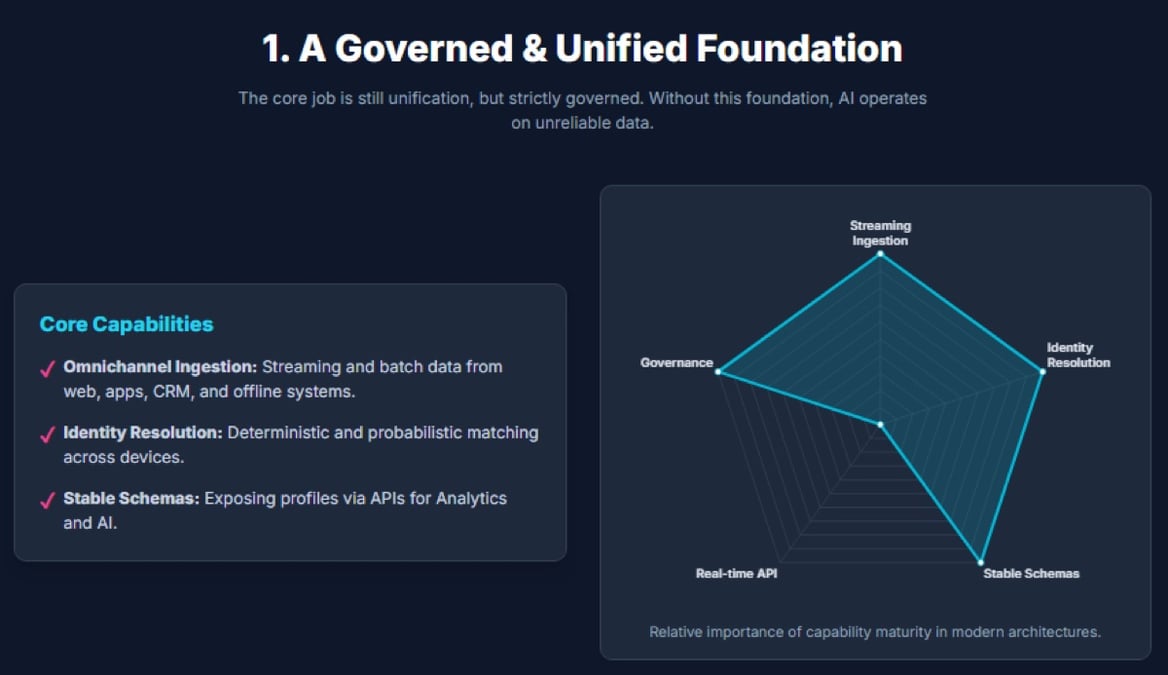
1. Provide a governed and unified first-party data foundation
The core job of a CDP is still to unify first-party data from multiple channels into actionable profiles. This is not only a technical concern; it is commercial.
Recent market research suggests that the global CDP market is growing at roughly 30 percent compound annual growth and is expected to reach tens of billions of dollars in value over the next decade, driven largely by demand for customer-centric data foundations in marketing, product and service use cases (MarketsandMarkets, 2024; Data Bridge Market Research, 2024).
From a capability point of view, a modern CDP should be able to:
- Ingest streaming and batch data from web, apps, CRM, commerce, service and offline systems
- Perform deterministic and, where relevant, probabilistic identity resolution across devices and channels
- Represent both anonymous and known identities and support account or household structures where needed
- Expose profiles and events via stable schemas and accessible APIs for analytics, AI and activation
Marchitechs’ own work on CDP architectures frames this as enabling data orchestration use cases for engineers, robust services for developers and transparent governance for IT and data leaders (Marchitechs, 2025).
Without this unified and governed foundation, AI and personalisation simply operate on partial or unreliable data.
2. Support “less-copy” and warehouse-native data patterns
Traditional CDPs often ingest and store a full copy of customer data. This is increasingly challenged by cost, complexity and regulatory pressure. In parallel, more organisations are consolidating analytical data into cloud data warehouses and lakehouses.
Zero-copy and “less-copy” designs aim to minimise redundant copies by querying data where it already lives and only maintaining edge stores where latency or resilience requires it (Clark, 2025). Industry analyses of these architectures report material reductions in storage and integration cost when redundant copies are removed and governance is centralised.
Marchitechs’ analysis is pragmatic: a “zero-copy CDP” is rarely literally zero-copy. To support real-time experiences, some data has to live at the edge. The practical target is a “less-copy CDP” where:
- The warehouse or lakehouse is the system of record
- CDP components query or materialise data from that platform under clear governance
- Any CDP-side stores are explicit, limited and justified by latency or cost
A modern CDP should therefore integrate natively with the organisation’s data platform, not compete with it.
3. Enable real-time data, scoring and decisioning
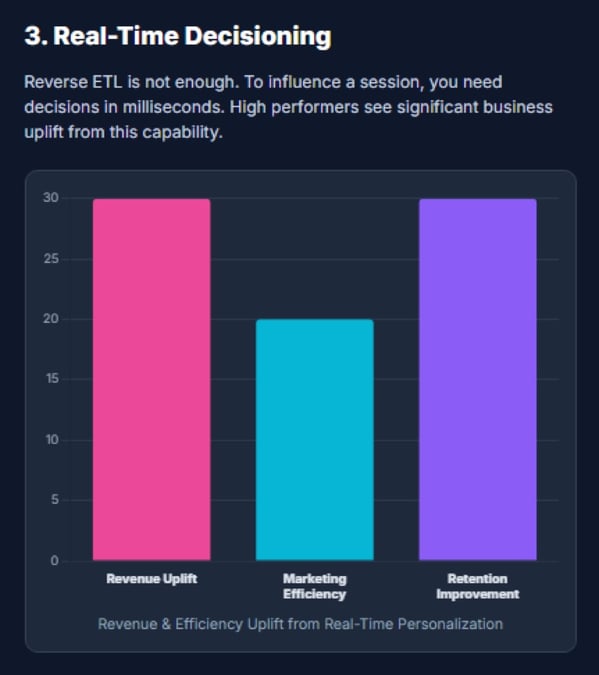
Reverse ETL can move data from a warehouse into activation tools, but it is not sufficient for in-session personalisation. It does not, by itself, provide continuous event capture, live profile updates and decisioning within the same time window.
Research on personalisation at scale indicates that companies that do this well can see 10 to 30 percent uplift in revenue and retention, and 10 to 20 percent improvements in marketing efficiency (McKinsey & Company, 2021; Yakuel, 2024). These effects rely on timely decisions, not only on better audience definitions.
For that, a modern CDP should be able to:
- Capture events from channels in real time and update profiles and segments within hundreds of milliseconds
- Execute machine learning models (for example propensity, churn, next-best-offer) within or near the same interaction window
- Return decisions or scores to websites, apps, contact centres and other channels fast enough to influence the experience
Marchitechs’ CDP landscape analysis shows that integrated and suite CDPs increasingly combine real-time profiles, audience services and an ML runtime in one environment, whereas composable approaches often rely on external components and careful integration to achieve the same effect (Marchitechs, 2025).
The practical test is simple: if a customer’s behaviour changes right now, can the CDP help you react within the same session.
4. Act as an AI and analytics engine, not only a database
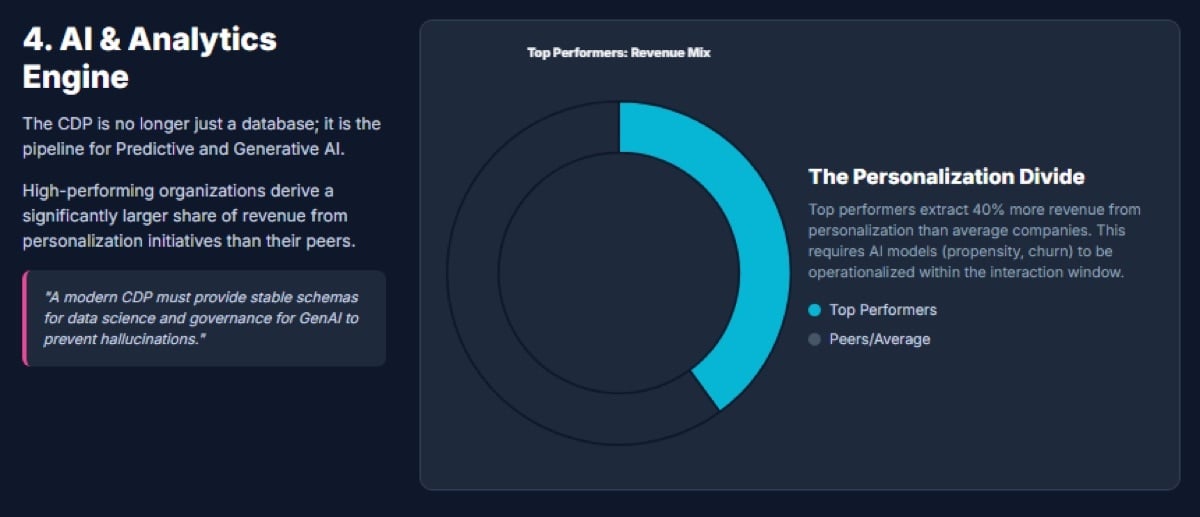
Modern personalisation strategies rely heavily on AI. This includes predictive models for scoring and segmentation and, increasingly, generative AI for content, offers and messaging.
Studies of personalisation show both upside and risk. High-performing organisations derive a significantly larger share of revenue from personalisation initiatives than their peers, with some analyses citing around 40 percent more revenue contribution from personalisation among top performers (McKinsey & Company, 2021; Yakuel, 2024). At the same time, surveys indicate that a majority of consumers feel frustrated when personalisation misses the mark, and poor personalisation can reduce repeat purchase and raise regret (Gartner, 2025; McKinsey & Company, 2021).
For a CDP, this translates into several concrete requirements:
- Data that is genuinely usable for modelling: stable schemas that combine behaviour, profile, transactions and context
- Simple extraction of training data and features for data science teams
- A deployment path where models can be operationalised within the CDP’s decisioning or closely adjacent services
- Monitoring of model performance and fairness by audience, channel and outcome
Generative AI adds two more:
- A clear pattern for using customer data as input signals for content or journey generation without leaking sensitive information into prompts or outputs
- Governance and guardrails around hallucinations, bias and safety
Marchitechs’ ebook describes how integrated and suite CDPs now ship with pre-built models and runtimes for common use cases such as propensity scoring and next-best-action, while composable or warehouse-native CDPs more often rely on dedicated ML platforms and tighter MLOps practices (Marchitechs, 2025).
A modern CDP should therefore be tightly connected to, or inclusive of, an AI lifecycle rather than treated as a passive data source
5. Orchestrate journeys and decisions across channels
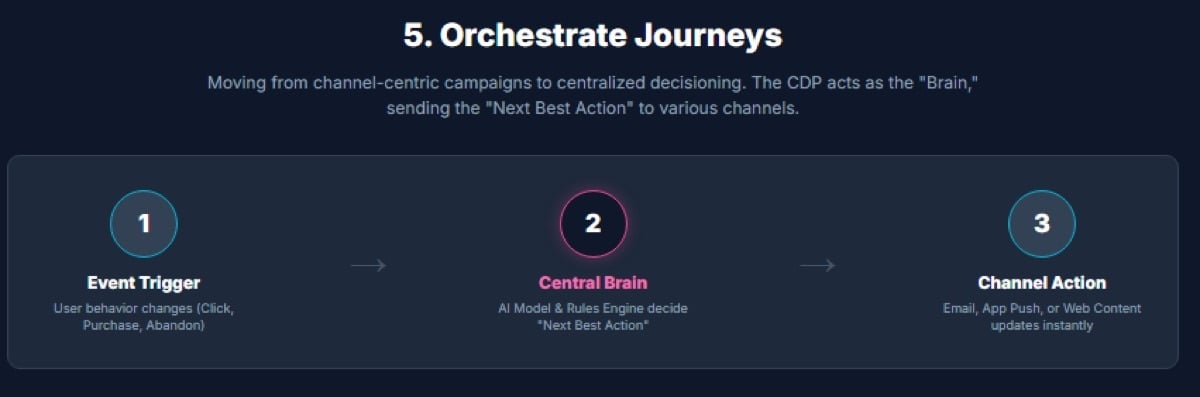
Without cross-channel orchestration, each activation tool ends up building its own partial view of the customer and optimising locally. CDPs emerged partly to address this by centralising profiles and audiences. The next step is centralised decisioning.
Modern research and practitioner reports describe a shift from channel-centric campaign tools to journey-centric decision engines that operate across email, mobile, web, paid media and service channels. These engines draw on unified profiles, AI models and business rules and expose “next action” and “next message” decisions to channels in real time.
A modern CDP should therefore:
- Provide a central audience and decision service that channels can call synchronously and asynchronously
- Support always-on, event-driven journeys as well as batch campaigns
- Allow experiments and optimisation at the journey level, not only per message
Marchitechs’ analysis distinguishes composable setups, where this orchestration often sits in separate tools, from integrated and suite CDPs, where journey orchestration is increasingly first-class and channel agnostic (Marchitechs, 2025).
The economic case is closely linked to the personalisation uplifts mentioned earlier: orchestrated journeys are how models and data turn into measurable downstream value.
6. Enforce privacy, consent and governance by design
CDPs are becoming central to privacy strategy, not only to marketing.
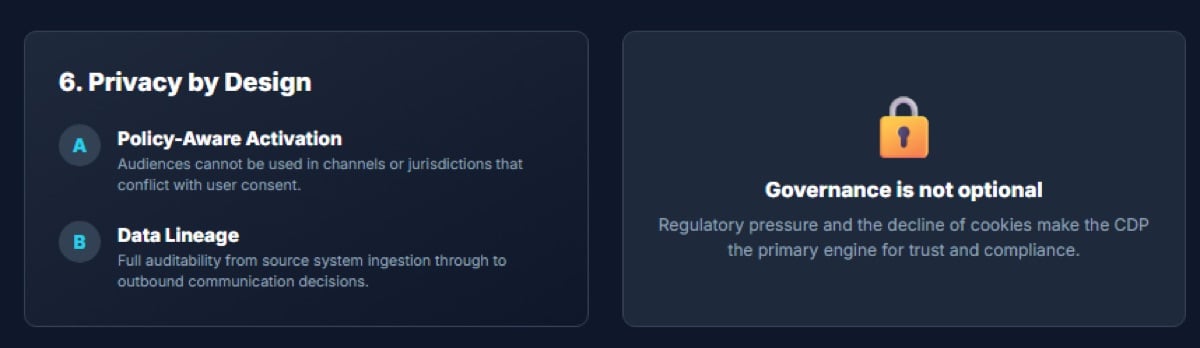
Regulatory developments and the decline of third-party cookies have pushed organisations toward first-party and zero-party data strategies. CDPs sit at the intersection of collection, governance and activation. Market analyses of CDP adoption explicitly call out privacy compliance and consent management as primary drivers alongside personalisation and customer experience (Data Bridge Market Research, 2024).
For that reason, a modern CDP should be able to:
- Maintain central consent and preference records that activation tools can query at decision time
- Enforce policy-aware segmentation and activation so that audiences cannot be used in channels, jurisdictions or purposes that conflict with consent
- Provide auditability and data lineage from source systems and events through to decisions and outbound communications
Less-copy and warehouse-native designs support this by keeping sensitive data under consistent security and governance controls and reducing the number of uncontrolled copies (Clark, 2025).
In practice, this means treating privacy and governance as first-class design constraints, not features added late in a project.
7. Fit the organisation’s maturity and operating model
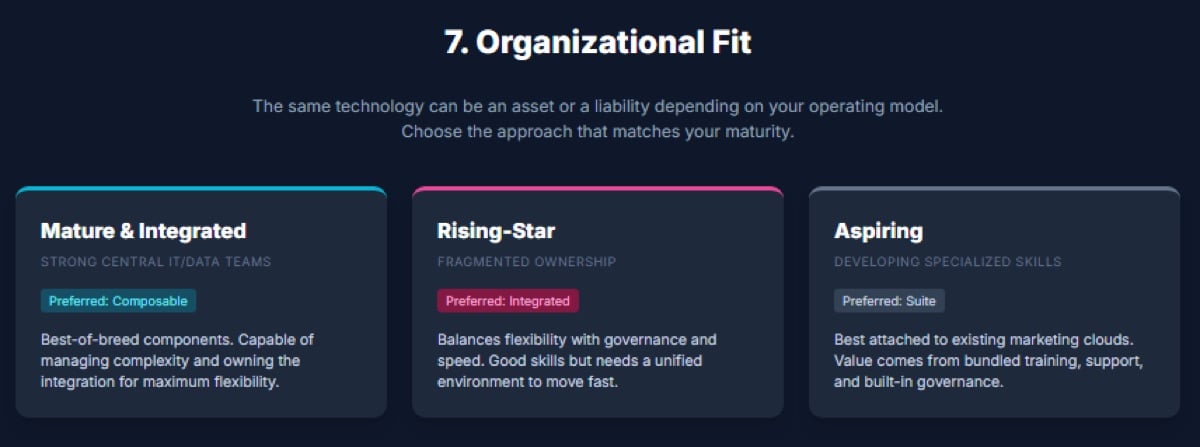
Technology has to fit organisational reality. Marchitechs’ CDP framework distinguishes three broad organisational archetypes (Marchitechs, 2025):
- Mature and integrated MarTech organisations Typically have strong central teams in IT, data and marketing and can benefit from composable CDPs, with best-of-breed components and more in-house ownership.
- Rising-star organisations Have good skills but more fragmented ownership. Integrated CDPs often provide a reasonable balance between flexibility, governance and speed.
- Aspiring organisations Are still building specialised skills and often get more value from suite CDPs attached to existing marketing clouds or ecosystems, where training, support and governance are bundled.
The same feature set can be an asset or a liability depending on whether the organisation can design, operate and evolve the platform. A modern CDP strategy is therefore as much about operating model, skills and partners as it is about product selection.
Summary: a practical checklist
From a scientific and practical perspective, a modern CDP should be able to:
- Unify and govern customer data across sources with robust identity resolution and accessible schemas.
- Integrate with the enterprise data platform using warehouse-native or “less-copy” patterns instead of uncontrolled duplication.
- Capture, enrich and decide in real time, not only sync batched audiences.
- Act as an AI and analytics engine, or at least be tightly integrated with one, from data to model deployment and monitoring.
- Orchestrate omnichannel journeys through centralised, AI-assisted decision services.
- Enforce privacy, consent and governance as part of core workflows.
- Align with organisational maturity, choosing composable, integrated or suite approaches that match skills and constraints.
For CMOs, CIOs and data leaders, this checklist offers a more grounded way to challenge both vendors and internal proposals. The key question is not whether a solution is labelled a “CDP”, but whether it can actually do the things that a modern CDP must do in an AI-driven, regulated environment.
Written by Martin Schierning Wammen, Jens Borgkvist, Troels Rem and Anders Bjørn-Strunge
The content and perspectives are based on experiences managing, implementation of CDPs, Marketing Suites, and customer data infrastructure projects across multiple industries in Nordic and global enterprises. The point-of-view is European-centric in terms of business,technology, and data privacy context
References
Clark, S. (2025) ‘Why zero-copy data is redesigning the modern CDP’, CMSWire, 19 November.
Data Bridge Market Research (2024) Customer Data Platform Market – Global Industry Trends and Forecast to 2031. Pune: Data Bridge Market Research.
Gartner (2025) Customer Personalization: Balancing Experience, Regret and Trust. Stamford: Gartner.
Marchitechs (2025) Navigating the CDP Landscape: A Guide for Data Savvy CMOs and CIOs. Copenhagen: Marchitechs.
MarketsandMarkets (2024) Customer Data Platform Market by Component, Application, Deployment Mode, Organization Size, Vertical and Region – Global Forecast to 2030. Northbrook: MarketsandMarkets.
McKinsey & Company (2021) ‘The value of getting personalization right or wrong is multiplying’, McKinsey Insights.
Yakuel, P. (2024) ‘Personalisation as a growth driver: how leaders capture more revenue’, MarTech Series.